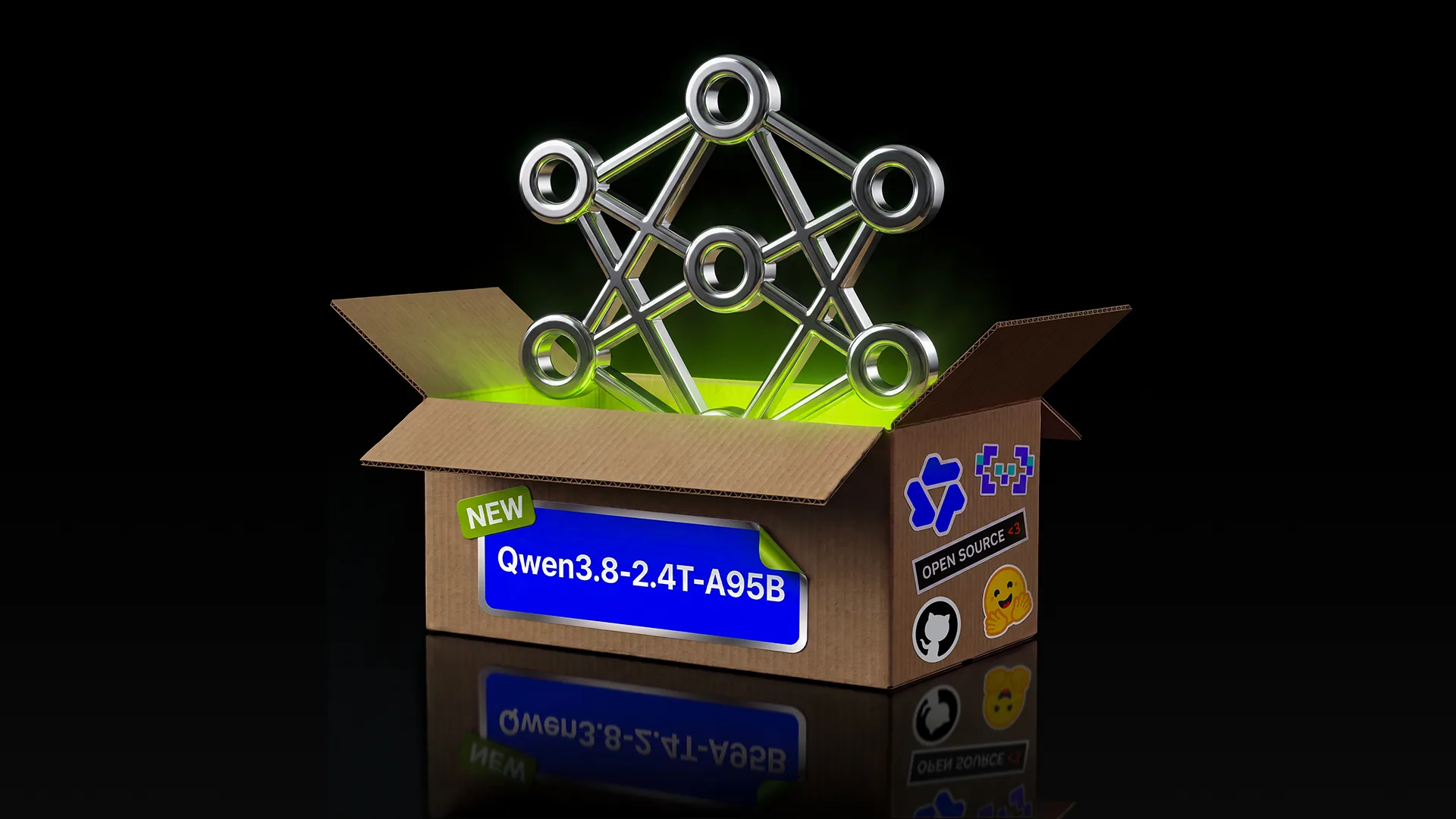
Alibaba has released the open weights for Qwen3.8-2.4T-A95B (Qwen3.8-Max), its largest open-weight model, which features 2.4T total parameters with 95B activated per token. NVIDIA is collaborating with the open-source ecosystem to enable multinode deployments of this model, providing optimized kernels, inference runtimes, and distributed serving recipes.
This model is designed for demanding reasoning and agentic workloads, offering a context window of up to one million tokens and an output length of up to 128K.
Key Points
- Alibaba released the open weights for Qwen3.8-2.4T-A95B (Qwen3.8-Max), its largest open-weight model.
- The model has 2.4T total parameters with 95B activated per token and a context window of up to one million tokens.
- It uses a fine-grained mixture of experts (MoE) architecture with a hybrid of full and linear attention.
- On Day 0, the model achieves over 4K tokens per second per GPU and over 350 tokens per second per user on NVIDIA GB300 NVL72 in FP8 precision.
- Built-in reasoning controls (low/high/xhigh) allow developers to configure inference depth per request.
- The NVIDIA GB300 NVL72 integrates 72 NVIDIA Blackwell Ultra GPUs into a single platform.
- Developers can deploy the model using a model-free NVIDIA NIM or via SGLang, vLLM, and NVIDIA Dynamo.
Context
According to the NVIDIA Developer Blog, deploying a 2.4T parameter open-weight model requires data-center-scale accelerated compute. Inference at this scale depends on extreme co-design across chips, system architecture, and software. NVIDIA is working to bring the model to multinode deployments.
Why It Matters
This development enables AI factories to run large-parameter models like Qwen3.8-2.4T-A95B in production with high throughput and low latency, addressing complex agentic workloads such as coding and large-scale document analysis.
What To Do
- Download Qwen3.8-2.4T-A95B model weights from Hugging Face or ModelScope.
- Deploy the model using a model-free NVIDIA NIM from NVIDIA NGC.
- Explore NVIDIA NeMo AutoModel for post-training and fine-tuning the model for domain-specific use cases.
- Test the configurable reasoning controls (low/high/xhigh) to balance compute and reasoning quality for different tasks.