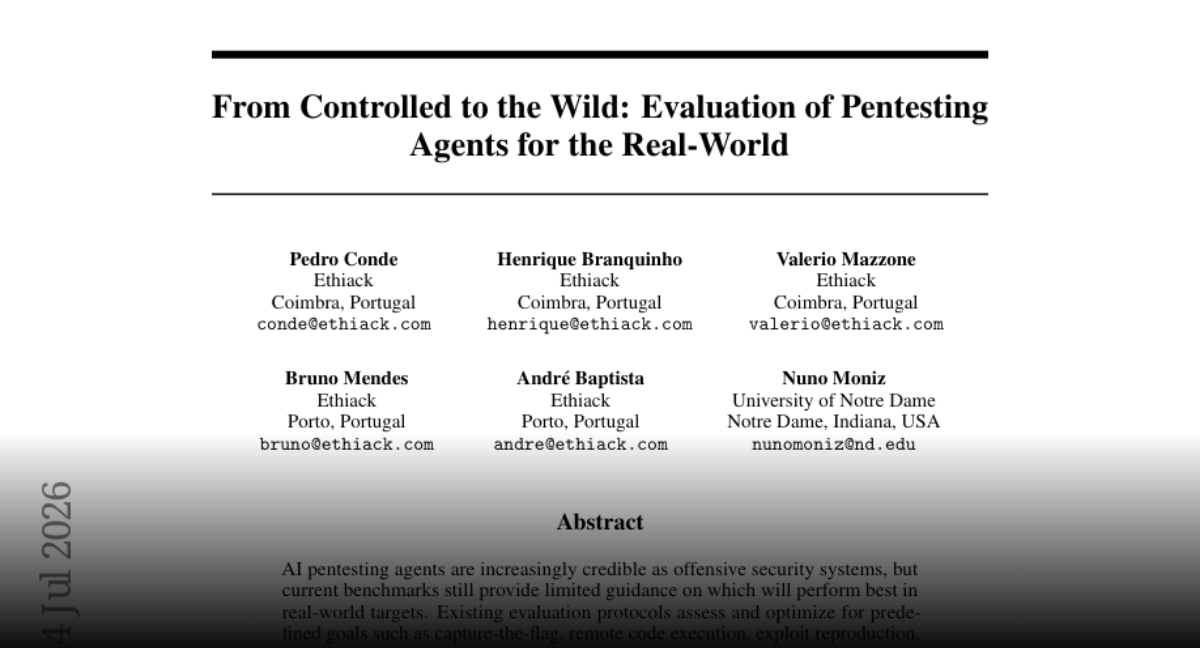
A paper published on Hugging Face on July 14, submitted by Pedro Conde on July 16, introduces a practical evaluation protocol for AI pentesting agents. The authors, affiliated with Ethiack, propose a method to assess these agents in real-world scenarios, moving beyond traditional benchmarks that focus on predefined goals or simplified settings.
Key Points
- Current AI pentesting benchmarks often assess agents based on predefined goals like capture-the-flag or remote code execution in narrow settings.
- These existing evaluations do not adequately capture the complexity and open-ended exploration required for realistic pentesting.
- The new protocol shifts assessment from task completion to validated vulnerability discovery in complex targets.
- It combines structured ground-truth with LLM-based semantic matching to identify vulnerabilities.
- The protocol incorporates bipartite resolution for scoring findings under ambiguity, continuous ground-truth maintenance, and repeated evaluation of stochastic agents.
- Efficiency metrics and reduced-suite selection are included for sustainable experimentation.
- Expert-annotated ground truth and code for the evaluation protocol have been released for reproducibility via GitHub.
Context
According to the authors, AI pentesting agents are becoming more credible as offensive security systems. However, existing benchmarks offer limited guidance on which agents perform best in real-world environments. Current evaluation protocols, while valuable for measuring bounded capabilities, do not fully address the strategic decision-making and complex exploration necessary for realistic pentesting, as stated by Ethiack.
Why It Matters
This new protocol offers a more realistic and operationally informative method for comparing AI pentesting agents. By focusing on validated vulnerability discovery in complex systems, it provides a more accurate measure of an agent's effectiveness in scenarios mirroring actual cybersecurity challenges. This approach can help developers and security professionals better understand the practical capabilities of AI in offensive security.