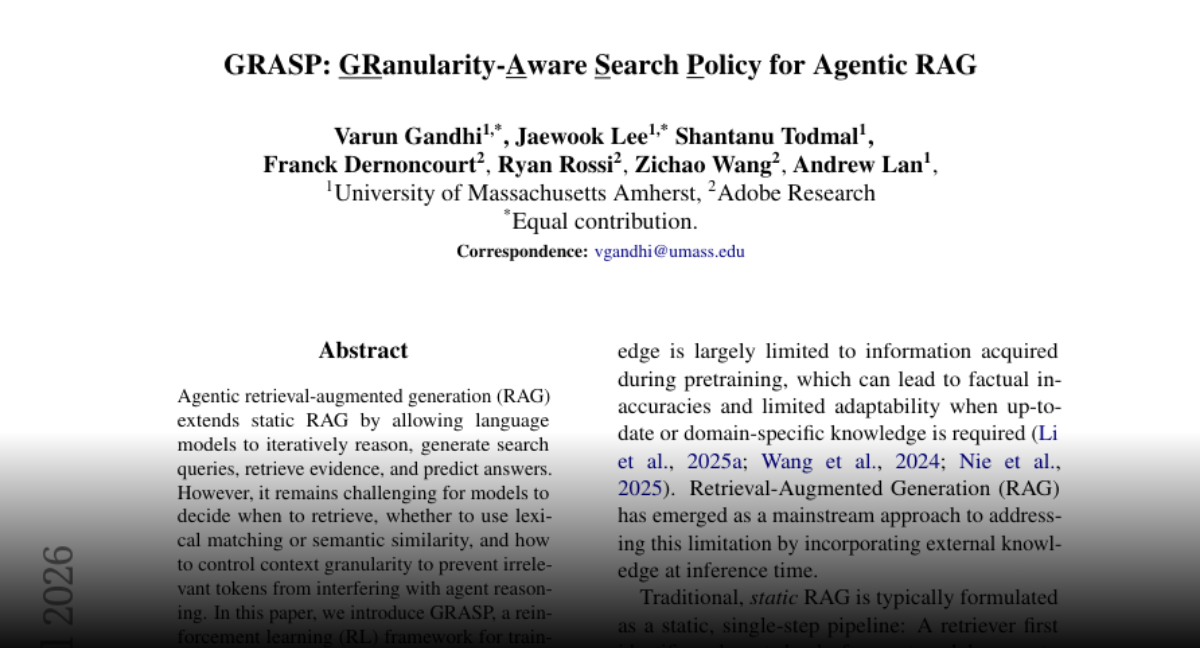
Hugging Face Daily Papers reports on GRASP, a new reinforcement learning (RL) framework developed to train agents for adaptive coordination of retrieval tools within multi-step reasoning processes. This framework addresses challenges in agentic retrieval-augmented generation (RAG), where language models iteratively reason, generate search queries, retrieve evidence, and predict answers.
Key Points
- GRASP is a reinforcement learning framework for agentic RAG.
- It trains agents to adaptively coordinate retrieval tools during multi-step reasoning.
- The framework provides agents with actions: semantic search, keyword search, and paragraph-reading.
- Agents can retrieve evidence at a sentence level and expand context only when necessary.
- GRASP's policy is trained using a reward function considering answer accuracy, grounded reading, complementary search, and turn efficiency.
- Experiments on multi-hop reasoning benchmarks indicate improved retrieval recall and question answering performance.
- GRASP reportedly outperforms single-step retrieval, prompting-based agentic RAG, and existing RL-based retrieval baselines.
Context
Agentic RAG systems encounter difficulties in determining when to retrieve information, whether to use lexical matching or semantic similarity, and how to manage context granularity. According to Hugging Face Daily Papers, these issues can lead to interference from irrelevant tokens during agent reasoning. GRASP aims to overcome these challenges by allowing agents to select retrieval strategies and manage context granularity adaptively. This promotes more efficient and targeted information retrieval.
Why It Matters
For practitioners and researchers working with RAG systems, GRASP offers a method to improve the precision and efficiency of information retrieval in complex reasoning tasks. By enabling agents to adaptively select retrieval strategies and manage context granularity, it provides a pathway to develop more robust and accurate AI systems that rely on external knowledge.