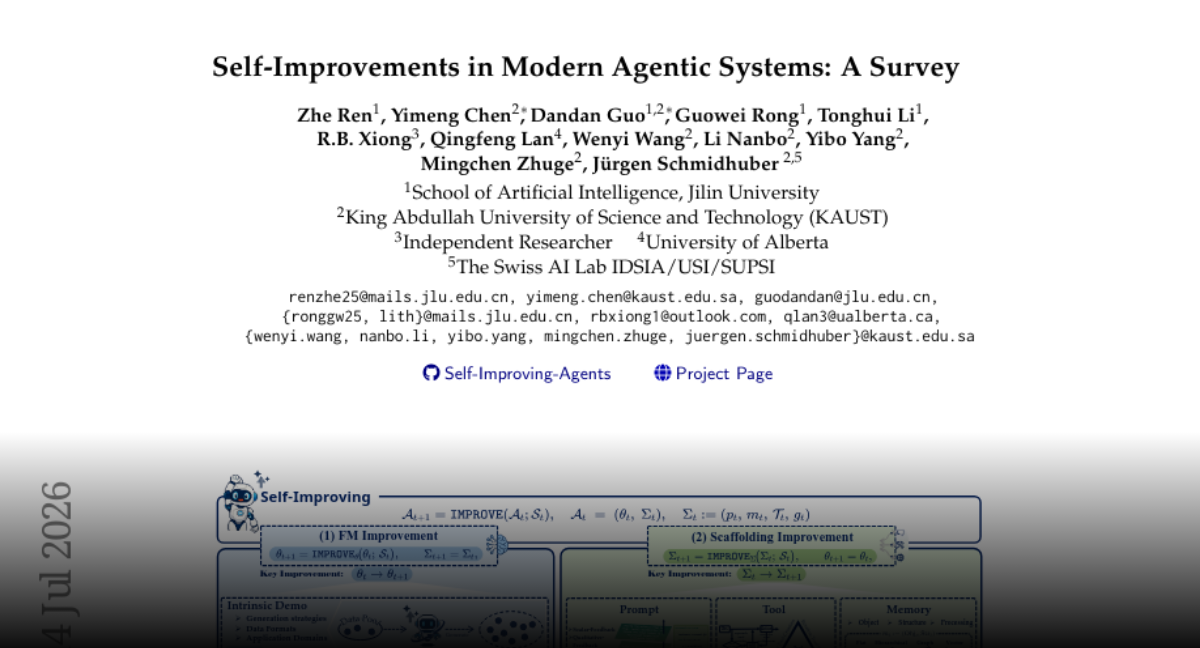
Hugging Face Daily Papers has released a survey titled "Self-Improvements in Modern Agentic Systems: A Survey." This paper explores the development of self-improving autonomous agents, tracing their progression from research prototypes to functional deployed systems. The survey emphasizes systems capable of learning from experience with minimal or no human intervention.
Key Points
- The survey frames modern self-improving agents as adaptive systems that convert experience into cumulative capability gains.
- It introduces a system-level framework, conceptualizing an agent as a configuration of a foundation model coupled with an operational scaffold.
- The operational scaffold includes prompts, memory, tools, and control logic.
- Self-improvement is formalized as a self-induced update operator that commits updates to either model parameters or scaffold components.
- Existing research is organized by two criteria: the update target within the agent system and the signals driving these changes.
- The survey reviews applications and evaluation methods for self-improving agents.
- It concludes by outlining open problems and future research directions.
Context
According to Hugging Face Daily Papers, the survey's central focus is on controllable evolution and adaptation, aiming for systems that can learn from experience with minimal or no human intervention. The paper introduces a system-level framework that views a modern agent as a configuration. This configuration combines a foundation model with an operational scaffold, which encompasses prompts, memory, tools, and control logic. Within this framework, self-improvement is defined as a self-induced update operator responsible for obtaining and committing updates to either the model parameters or the components of the scaffold.
The survey organizes existing research by two primary criteria: the specific update target within the agent system and the signals that drive these changes. Following this structure, it reviews various applications of self-improving agents and discusses methods for their evaluation. The authors also maintain a repository for technical updates related to self-improving agents.
Why It Matters
For practitioners and researchers, this survey offers a structured understanding of self-improving agent systems, providing a common framework and terminology. By categorizing prior work based on update targets and driving signals, it assists in identifying current approaches and potential areas for innovation in designing agents that can autonomously adapt and enhance their capabilities over time.