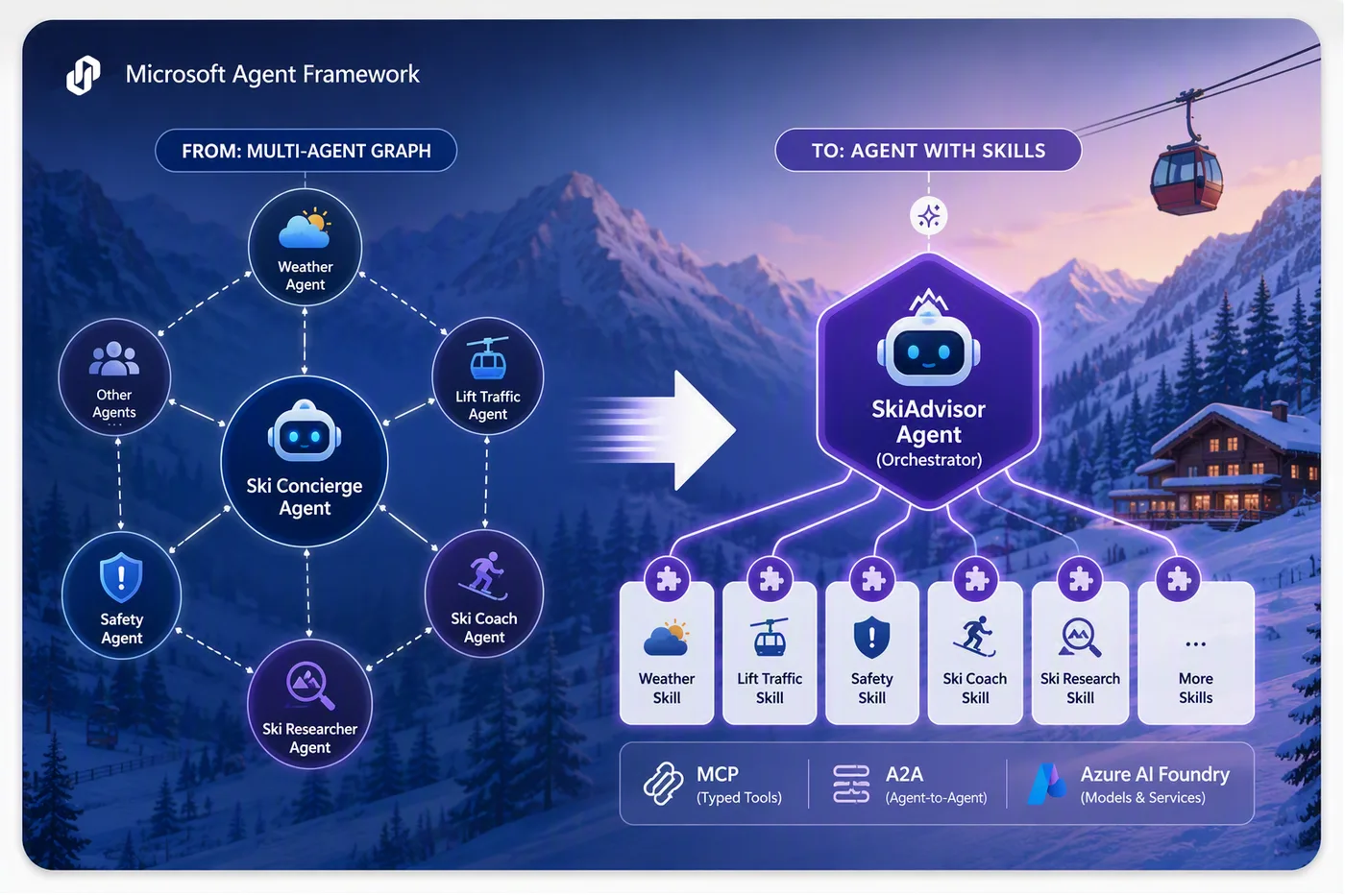
The Microsoft Agent Framework has introduced a new architectural approach for multi-agent systems, enabling distributed skills over the Model Context Protocol (MCP). This method provides an alternative to the traditional Agent-to-Agent (A2A) communication, where a central orchestrator delegates tasks to specialist agents.
Previously, a multi-agent system often involved a primary agent understanding a user's request, delegating to specialist agents, and then combining their responses. This was demonstrated in a ski resort demo where a resort advisor called specialists for weather, safety, ski coaching, and lift traffic. Each specialist in this original architecture owned its instructions and tools, and the advisor invoked them via A2A.
The new approach explores whether every specialist requires its own model execution or if the parent orchestrator primarily needs the specialist's instructions and access to its operations. To address this, a second architecture was added to the same application: distributed Agent Skills and tools served over MCP.
Key Points
- The Microsoft Agent Framework now supports distributed skills over Model Context Protocol (MCP) as an alternative to Agent-to-Agent (A2A).
- In the original A2A architecture, each specialist agent (e.g., weather, safety) was an independent reasoning component with its own model.
- The new skills architecture removes the need for a separate model within the specialist service for interpreting questions.
- Instead, a service publishes a description, a SKILL.md document, and typed MCP tools.
- The advisor loads these instructions and tool definitions to select the next operation, with the advisor host managing the flow using Microsoft Agent Framework (MAF).
- The ski resort demo maintains both A2A and MCP architectures side-by-side, with four specialists (weather, safety, ski coaching, lift traffic) having corresponding MCP providers.
- A web-research agent remains an ordinary agent tool in both advisor configurations.
Context
According to the Microsoft Semantic Kernel Blog, the core difference between the two architectures lies in where the reasoning happens. In the original A2A setup, an independent weather agent would interpret a delegated question, select its tools, and formulate a response. The advisor would then interpret this response to produce the final answer. This is suitable when a specialist requires autonomy, a private context, or an independent lifecycle.
With the skills architecture, the weather service no longer needs a model to interpret the question. Instead, it publishes a SKILL.md document and typed MCP tools. The advisor loads these instructions and uses the tools to select the next operation. The Microsoft Agent Framework (MAF) manages this flow on the advisor host. This means the domain no longer adds its own nested reasoning loop, though producing an answer can still involve multiple model requests.
Why It Matters
This architectural shift offers builders a choice in designing multi-agent systems, potentially optimizing for scenarios where a specialist's competence is bounded and does not require an independent reasoning model. Understanding this distinction can influence system complexity, resource allocation, and the distribution of intelligence within an agent ecosystem.
What To Do
- Note that MCP does not replace A2A everywhere; they address different boundaries.
- Consider separating a specialist's instructions, agent/model runtime, and business system functions before changing protocols.
- Review existing specialist system prompts to extract domain rules, interpretation guidance, and safety priorities for potential migration to a SKILL.md description.
- Examine the provided examples of MCP endpoint resource surfaces, such as
skill://index.jsonandskill://<skill-name>/SKILL.md, to understand skill discovery.
Keep Exploring
/techniques/role-objective /techniques/output-schema /techniques/system-user-separation