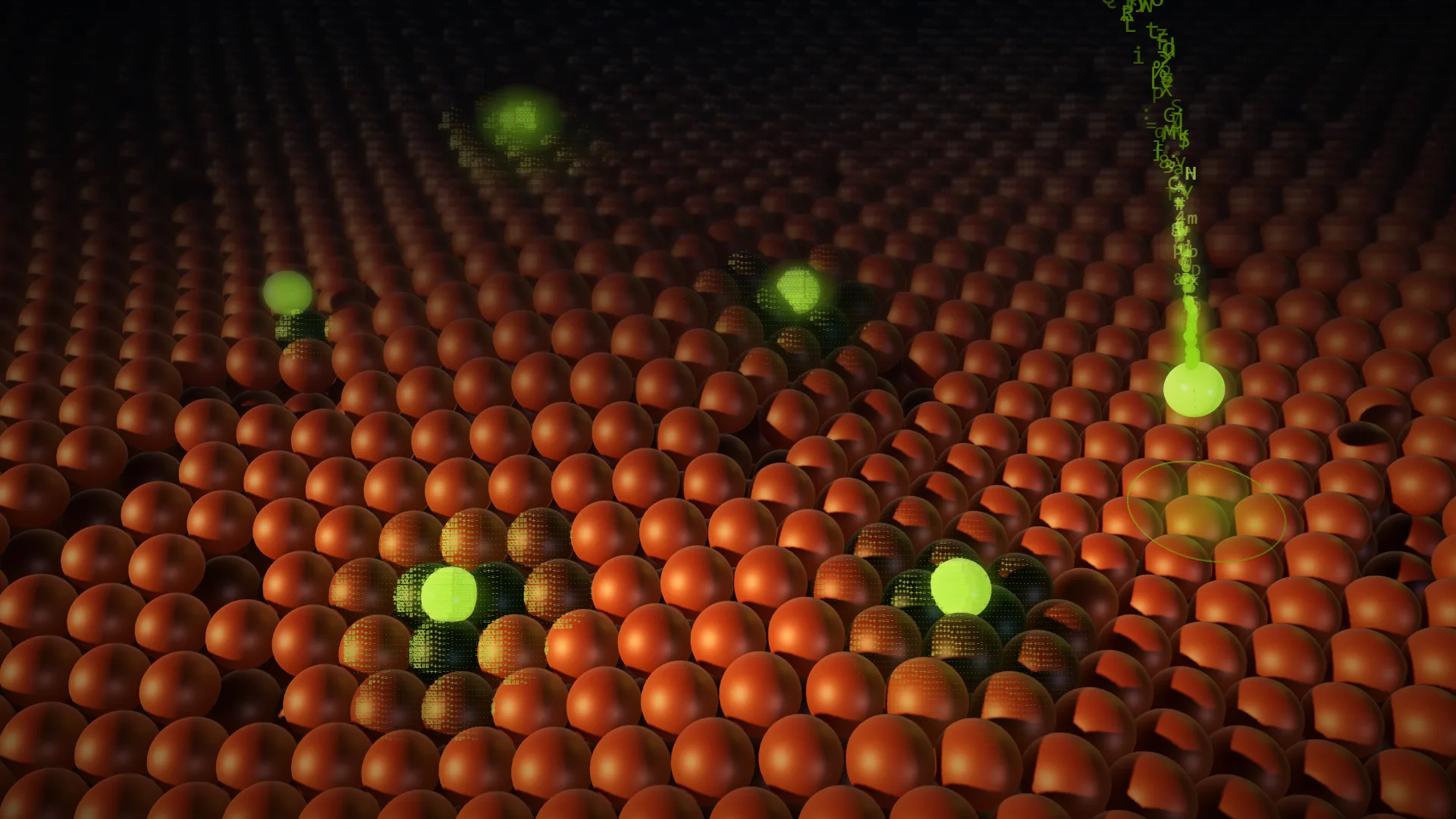
The NVIDIA ALCHEMI Toolkit, released earlier in 2026, facilitates composable, PyTorch-native, GPU-accelerated workflows for Machine Learning Interatomic Potentials (MLIP). It uses agent skills and reference files to connect natural-language prompts with robust simulation code generation on NVIDIA GPUs. This toolkit addresses the challenge of accessible interfaces in atomistic simulation, particularly for the nascent MLIP ecosystem.
Systematic benchmarks involving 45 pipelines across various prompt specificity levels demonstrated that prompt detail influences code structure and reusability, but not physical correctness. All workflows—including silicon equation of state, oxygen adsorption on Cu(111), and lithium self-diffusion—yielded results consistent with established references when validated on NVIDIA H200 GPUs. Despite these automation advancements, scientific judgment and independent validation against experimental or DFT data remain crucial, as MLIP models like MACE-MPA-0 can exhibit variable accuracy outside their training domains, and coding agents do not inherently verify the physical plausibility of simulation tasks.
Key Points
- The NVIDIA ALCHEMI Toolkit was released earlier in 2026.
- It enables GPU-accelerated workflows for Machine Learning Interatomic Potentials (MLIP).
- The toolkit uses agent skills and reference files to generate simulation code from natural-language prompts.
- Benchmarks of 45 pipelines showed prompt detail affects code structure and reusability, but not physical correctness.
- All benchmark workflows were validated on NVIDIA H200 GPUs and produced results consistent with established references.
- The benchmark used Claude Code as the coding agent.
- Scientific judgment and independent validation remain critical for physical plausibility.
Context
According to the NVIDIA Developer Blog, atomistic simulation requires scientific knowledge, compute-efficient implementation, and accessible interfaces. The NVIDIA ALCHEMI Toolkit primarily addresses the second and third requirements, particularly for MLIPs, which often have different software stacks and data structures compared to classical force fields. AI coding agents offer a solution by generating and executing code from natural-language descriptions, with ALCHEMI Toolkit agent skills providing the necessary API patterns.
Why It Matters
This development from NVIDIA offers builders a method to accelerate materials simulation workflows using AI coding agents, potentially reducing the barrier to entry for complex MLIP simulations. The ability to generate robust, GPU-accelerated code from natural language can streamline research and development in materials science.
What To Do
- Note that the NVIDIA ALCHEMI Toolkit was released earlier in 2026.
- Install the ALCHEMI Toolkit in a runnable Python environment using
uvpackage manager. - Download agent skills from the same release tag as the installed ALCHEMI Toolkit.
- Install a coding agent such as Claude Code and allow it to execute generated scripts.
- When prompting, name the system, method, and scale explicitly to improve output quality.