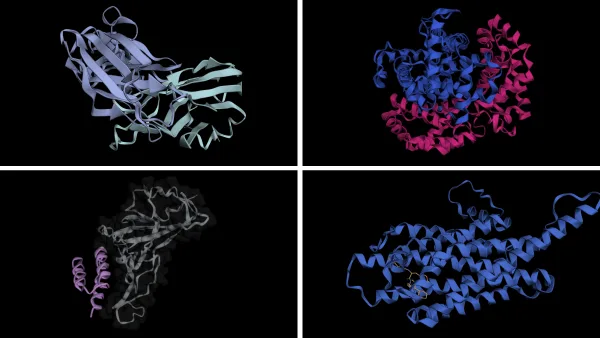
NVIDIA has released BioNeMo Inference Runtime (BioIR), a tool designed to accelerate biomolecular structure prediction models on NVIDIA GPUs. This runtime integrates with existing PyTorch workflows and provides an end-to-end processor for tasks ranging from input parsing to PDB or mmCIF output.
BioIR optimizes performance through kernel selection, module optimization with CUDA Graph capture, and pipeline scaling via Ray replicas. These optimizations target different bottlenecks in the structure prediction process.
Key Points
- NVIDIA BioNeMo Inference Runtime (BioIR) accelerates biomolecular structure-prediction models on NVIDIA GPUs.
- It supports an end-to-end processor that handles parsing, tokenization, feature generation, GPU inference, and PDB or mmCIF output.
- BioIR can integrate directly with PyTorch modules for custom code.
- For large worklists, the Ray executor places a complete model replica on each GPU in a single node to increase throughput.
- A benchmark of 1,000 human dimer targets on 8xH100 GPUs showed BioIR-accelerated Boltz-2 delivered 58.5K successfully folded residues per allocated GPU-hour, a 2.90x improvement over a torch-compiled open-source implementation.
- The estimated rated-power-equivalent energy to fold one million comparable targets is 11 MWh for BioIR versus 35 MWh for the public implementation.
- BioIR was used in the expansion of the AlphaFold Database (AFDB), accelerating the generation of protein-complex structures across 4,777 proteomes, totaling approximately 31 million candidate complexes.
Context
Biomolecular structure prediction is frequently performed at a proteome scale, requiring efficient processing of entire worklists. According to NVIDIA, BioIR addresses this need by providing an optimized runtime environment.
Why It Matters
Builders can achieve higher throughput and reduced energy consumption for biomolecular structure prediction tasks. This can accelerate research and development in areas like drug discovery by enabling faster processing of large datasets.
What To Do
- Explore the BioNeMo Inference Runtime repository to integrate it into structure prediction workflows.
- Check the BioNeMo Agent Toolkit for further acceleration of drug discovery workflows with agentic orchestration.
- Consult the API reference and support matrix for the latest acceleration numbers.