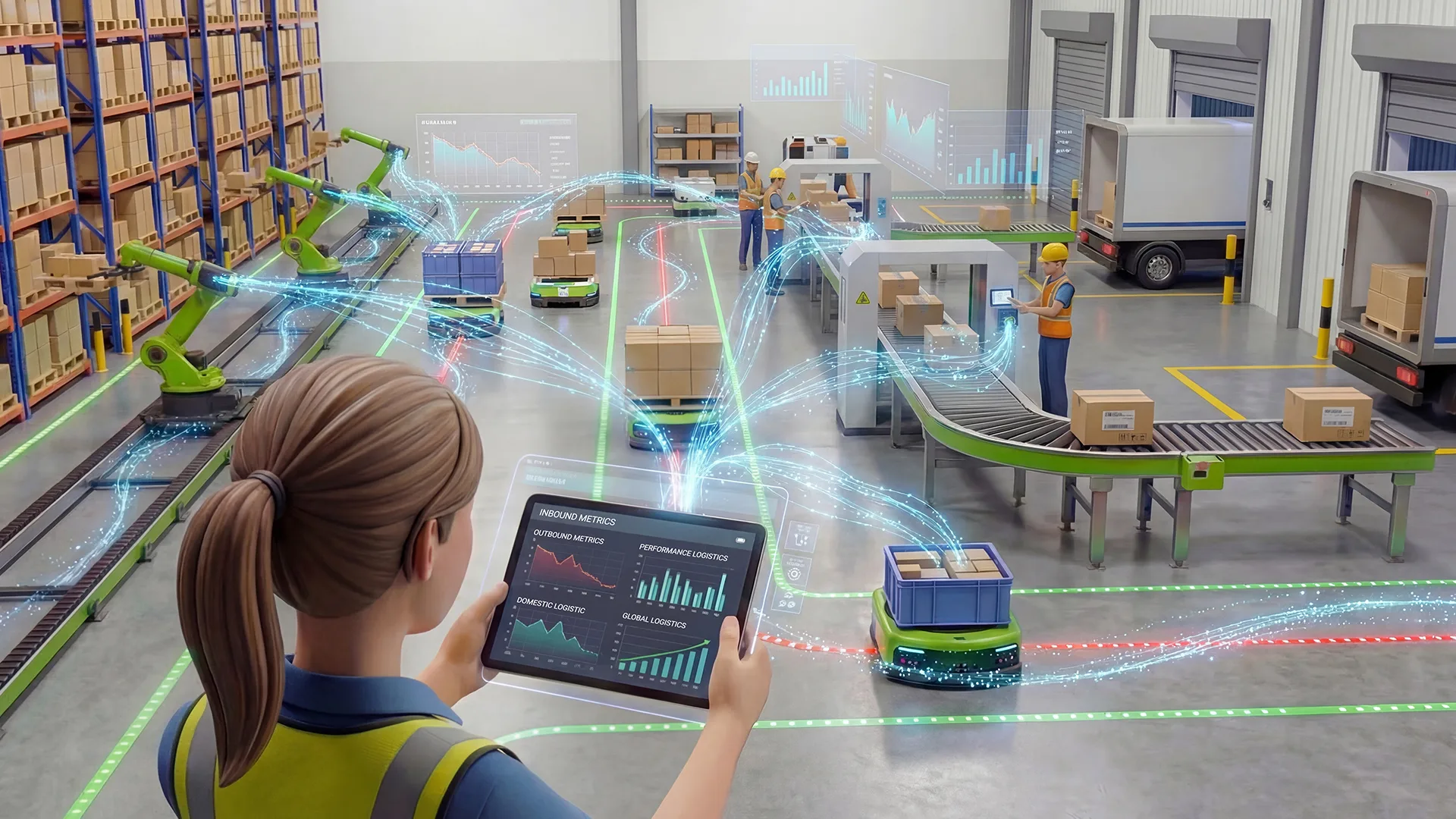
NVIDIA has integrated Nemotron 3.5 Lightning into its supply chain operations, aiming to codify human expertise for critical material allocation. The company, which manages a complex global supply chain, measures performance from "wafer-out to first token," encompassing the entire process from silicon leaving the fab to an assembled system becoming productive in a data center.
This initiative focuses on compressing the "time-to-rack" interval, which spans from silicon production to a system's arrival on a data center floor. NVIDIA's Grace Blackwell NVL72 platforms, for example, involve millions of parts and thousands of suppliers, making material allocation a complex weekly challenge.
Key Points
- NVIDIA built a Digital Supply Chain Intelligence command center on Palantir Foundry to unify material, capacity, and qualitative signals.
- NVIDIA cuOpt solves the weekly mixed-integer linear program to minimize Time of Ownership across manufacturing sites.
- Human planners consistently outperformed the quantitative model by incorporating qualitative signals like emails, weather forecasts, and geopolitical events.
- NVIDIA post-trained Nemotron 3.5 Lightning (a specialized 30B model) on captured allocation decisions, rationales, and outcomes.
- The training used NeMo Anonymizer, Data Designer, and AutoModel within a governed Palantir Autopilot lifecycle.
- The specialized 30B model achieved 86.7% allocation-decision accuracy on the development benchmark.
- This accuracy was 31.2 percentage points higher than the larger Nemotron 3 Ultra and 69.2 points higher than its own base model.
- Accepted, edited, and overridden recommendations feed back into the Ontology for future governed retraining runs.
Context
According to NVIDIA, its supply chain is one of the largest and most complex globally, with performance measured from "wafer-out to first token." The "time-to-rack" component, which is the focus of this effort, involves ensuring all components arrive for assembly. The "Time of Ownership" (TOO) metric tracks the duration from material receipt at a manufacturing site to its departure as part of a sub-assembly or product. The critical material allocation problem, manually reworked each week, involves deciding what and how much material to allocate to each manufacturing site for the current and next quarters.
NVIDIA collaborated with Palantir to create a unified view of all inputs for material allocation decisions within their Digital Supply Chain Intelligence command center. Palantir Foundry provides the operating context, with its Ontology connecting structured and unstructured data into a governed layer. This representation allows planners to simulate scenarios and forms the basis for an AI flywheel that compounds knowledge and improves performance over time.
Why It Matters
This initiative demonstrates a method for integrating human expertise, including qualitative and unstructured data, into AI models for complex operational decision-making. For builders, it highlights a practical application of post-training specialized models on proprietary datasets to achieve performance gains over larger, more general models, particularly in scenarios where human intuition and external factors are crucial.
What To Do
- Explore the Nemotron LoRA customization cookbook to understand how to adapt efficient open-weight models for agentic workflows.
- Access open Nemotron models on Hugging Face to experiment with their capabilities.
- Investigate NIM microservices on build.nvidia.com for deployment options of these models.
- Note the methodology of using tools like NeMo Anonymizer, Data Designer, and AutoModel for governed retraining within a platform like Palantir Autopilot.