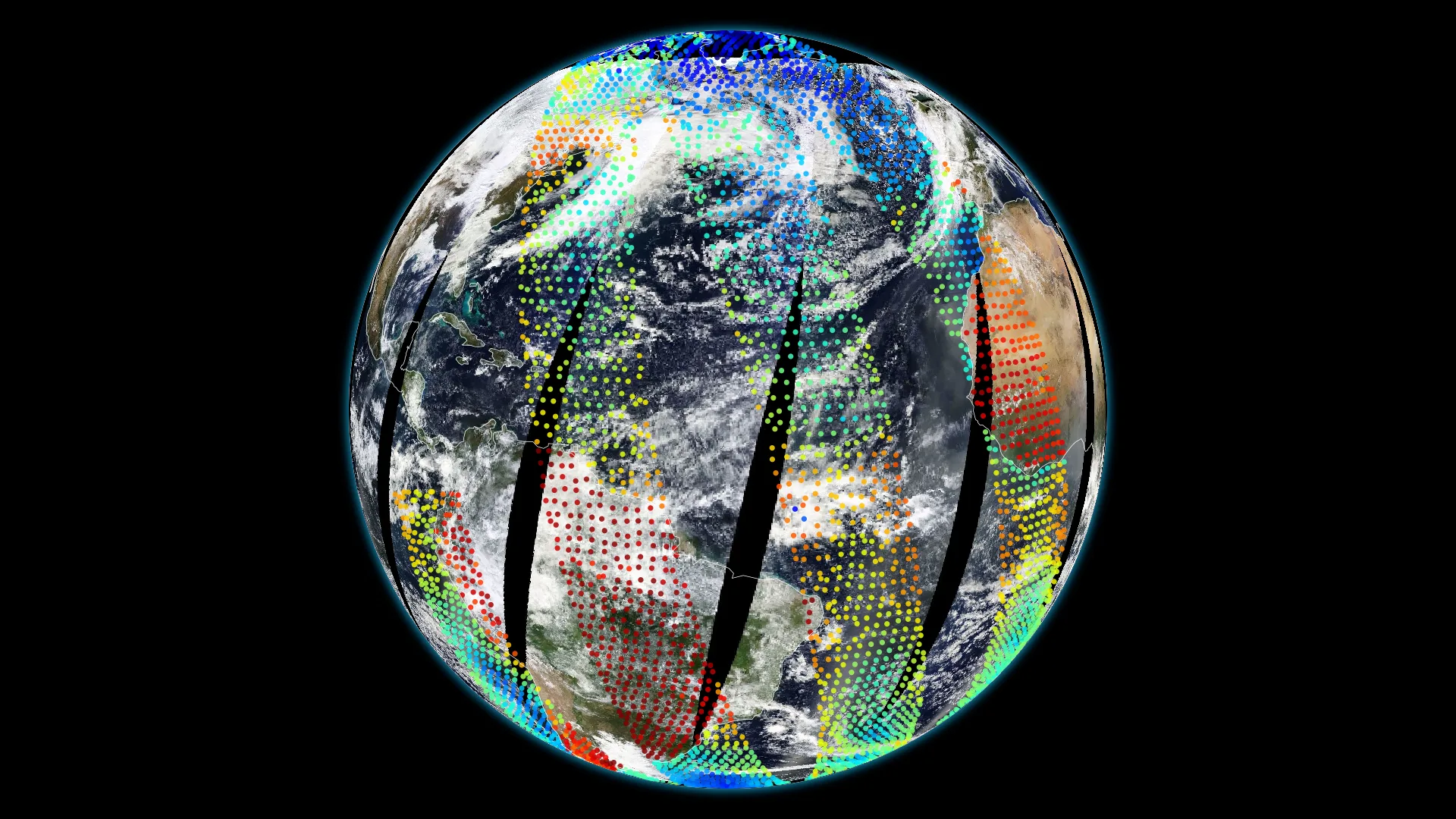
NVIDIA has detailed its Earth-2 AI data assimilation tools, designed to help weather-sensitive industries process observations more efficiently. These tools enable more frequent forecasts and better alignment with real-time conditions by incorporating proprietary or third-party data.
Key Points
- NVIDIA Earth-2 AI data assimilation tools process observations from proprietary or third-party sources.
- These tools aim to issue forecasts more frequently and align estimates with real-time conditions.
- Score-Based Data Assimilation (SDA) constrains diffusion models like StormCast and CorrDiff with point observations.
- SDA reduced wind-speed RMSE by 54% in a CorrDiff-COSMO downscaling example.
- SDA reduced wind-speed RMSE by an average of 7.2% across six StormCast-CONUS forecast steps.
- HealDA estimates the global atmospheric state in seconds by mapping heterogeneous observations onto a 1° HEALPix grid.
- Earth2Studio data sources provide unified access to gridded satellite and radar data, conventional observation archives, and operational observation streams.
Context
According to NVIDIA, weather-sensitive industries increasingly access observations that offer earlier, more local views of changing conditions. These observations come from sources such as energy companies collecting measurements across wind and solar assets, emergency management teams using radar and local sensors, and satellite providers continuously observing the Earth. The Earth-2 tools are designed to incorporate this data to tailor forecasting pipelines to specific regions and applications.
SDA integrates observations into diffusion-based AI downscaling and forecasting models without requiring model retraining. This process guides the model toward predictions consistent with observations. During the multi-step denoising process of diffusion models, SDA compares intermediate predictions with observations at each step, nudging the model. The output is probabilistic, with reduced uncertainty near observation locations.
Why It Matters
For builders and researchers, the NVIDIA Earth-2 tools offer a method to integrate diverse, real-time observational data into AI weather models. This capability can enhance the accuracy and timeliness of localized forecasts, which is critical for operational decisions in sectors such as energy, agriculture, and logistics.
What To Do
- Explore the end-to-end AI data assimilation examples available in the Earth2Studio example library.
- Follow the custom data source example to connect your own observations to a pipeline.
- Visit the Earth2Studio user guide to begin with AI data assimilation and explore broader AI weather model capabilities.