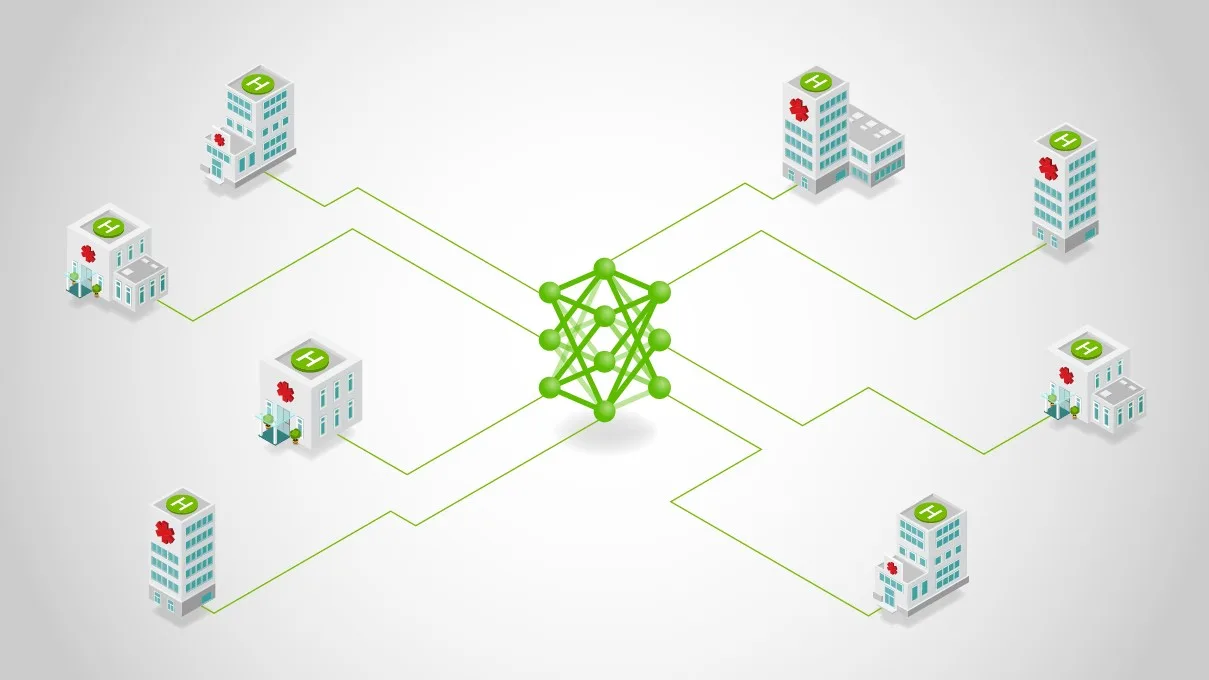
NVIDIA FLARE, a framework for federated learning, has expanded its deployment capabilities to integrate with Docker, Kubernetes, and Slurm. This development addresses the operational complexities that arise when federated learning projects grow and involve organizations with differing infrastructure preferences.
The framework's architecture separates persistent federation services from job execution processes. This allows each participating site to utilize its preferred execution backend while maintaining local control over compute allocation, datasets, images, secrets, and scheduling policies.
Key Points
- NVIDIA FLARE separates persistent federation services from dynamically launched job workers.
- This two-layer architecture allows each site to use Docker, Kubernetes, or Slurm for job execution.
- FLARE 2.8 introduced Docker and Kubernetes deployment support.
- FLARE 2.9 added Slurm support for HPC and shared GPU clusters.
- Parent processes remain available without occupying GPUs, while job workers request resources like GPUs, CPU units, and host memory.
- Studies can define logical multi-tenant boundaries within a single deployment, mapping to local datasets, secrets, approved images, and scheduling policies.
Context
According to the NVIDIA Developer Blog, federated learning projects often begin with a simple setup but quickly encounter challenges related to operating shared infrastructure. These challenges include allocating GPUs on demand, separating multiple research studies, and ensuring each participating organization retains control over its data, secrets, and compute policies. The blog notes that requiring all participants to adopt the same infrastructure can hinder collaboration.
Why It Matters
This update from NVIDIA addresses a key operational barrier for organizations engaging in federated learning. By supporting diverse infrastructure, NVIDIA FLARE removes the need for platform standardization as a prerequisite for collaboration, potentially increasing participation and the scope of federated learning initiatives.
What To Do
- Explore the NVIDIA FLARE documentation to understand configuration and job execution.
- Visit the NVIDIA FLARE GitHub repository to access the source code.
- Note the specific versions, FLARE 2.8 and FLARE 2.9, that introduced Docker, Kubernetes, and Slurm support, respectively.
- Consider how the two-layer architecture might impact resource allocation and management in your federated learning deployments.