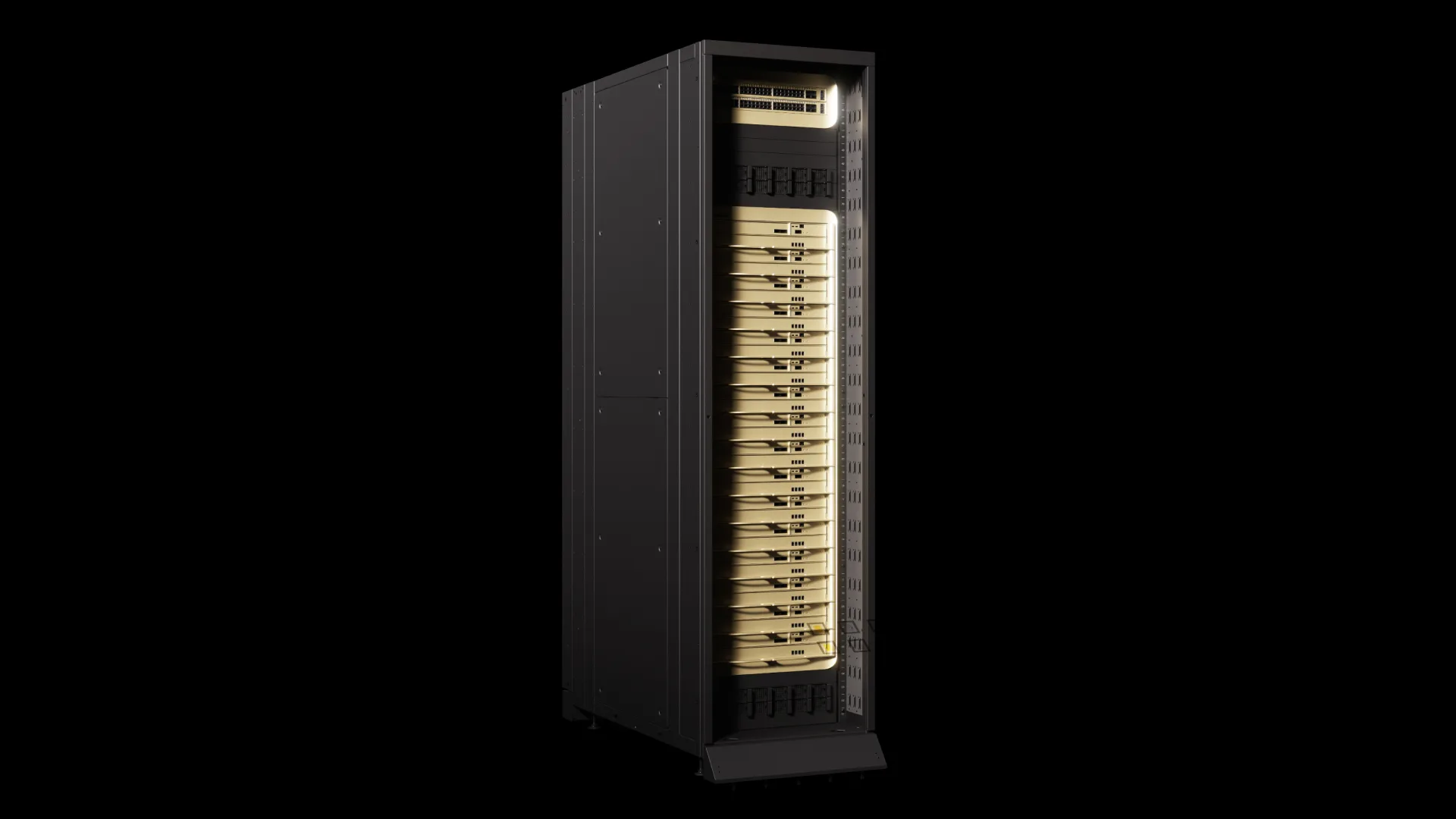
NVIDIA has detailed the performance of its Groq 3 LPX interactive AI inference accelerator, integrated with the NVIDIA Vera Rubin NVL72 platform. This system demonstrated high interactivity at long context lengths, as measured by a third-party benchmark.
Groq 3 LPX is designed to accelerate AI inference for the NVIDIA Vera Rubin platform, which aims to deliver high throughput and interactivity across various AI workloads. The integration expands Vera Rubin's capacity to support high-interactivity serving tiers for user experiences within AI factories.
Key Points
- NVIDIA Groq 3 LPX is an interactive AI inference accelerator for the NVIDIA Vera Rubin platform.
- The NVIDIA Vera Rubin NVL72 is described as a versatile machine for AI workloads, from small to large models.
- Groq 3 LPX, paired with Vera Rubin NVL72, achieved 3,431 output tokens/second on the Artificial Analysis 100K context benchmark using the Gemma 4 31B model.
- The system also delivered 4,767 median output tokens/second on SPEED-Bench for general agentic and coding-specific tasks.
- It supports co-execution configurations with Vera Rubin NVL72, including prefill-decode disaggregation, attention-FFN disaggregation, and speculative external-drafter decoding.
- The technology scales to multi-trillion parameter models and supports agentic multiturn inference with large, long-context models.
- Performance is powered by deterministic compiler-scheduled workload planning, fine-grained computation-communication overlap, and preplanned chip-to-chip networking.
Context
According to the NVIDIA Developer Blog, agentic sessions involve multiturn inference where context grows with each turn, potentially reaching hundreds of thousands of tokens. This necessitates systems that can process long contexts efficiently while maintaining high interactivity. The challenge in inference systems, particularly for high interactivity, involves managing tensor parallelism at small batch sizes, where coordination costs can outweigh the benefits of distributed computation. The blog states that the Groq 3 LPX addresses this by minimizing first-bit latency through its compiler-scheduled workload planning, which includes chip-to-chip (C2C) within-rack networking and overlapping compute with interprocessor communication.
Why It Matters
This development indicates a focus on addressing the system challenges of high-interactivity, long-context AI applications, particularly for agentic systems. For builders and researchers, the ability to maintain high throughput with long contexts at small batch sizes could enable more sophisticated and responsive AI agents, impacting the design and deployment of multi-agent systems and user-facing AI applications.
What To Do
- Note the benchmark results from Artificial Analysis for the Gemma 4 31B model on Groq 3 LPX.
- Review the described mechanisms, such as compiler-scheduled workload planning and chip-to-chip networking, for managing low-latency and long-context inference.
- Consider the implications of supporting multi-trillion parameter models and agentic multiturn inference for future system designs.
Keep Exploring
/atlas/**gemini**-family /techniques/multishot /techniques/system-user-separation