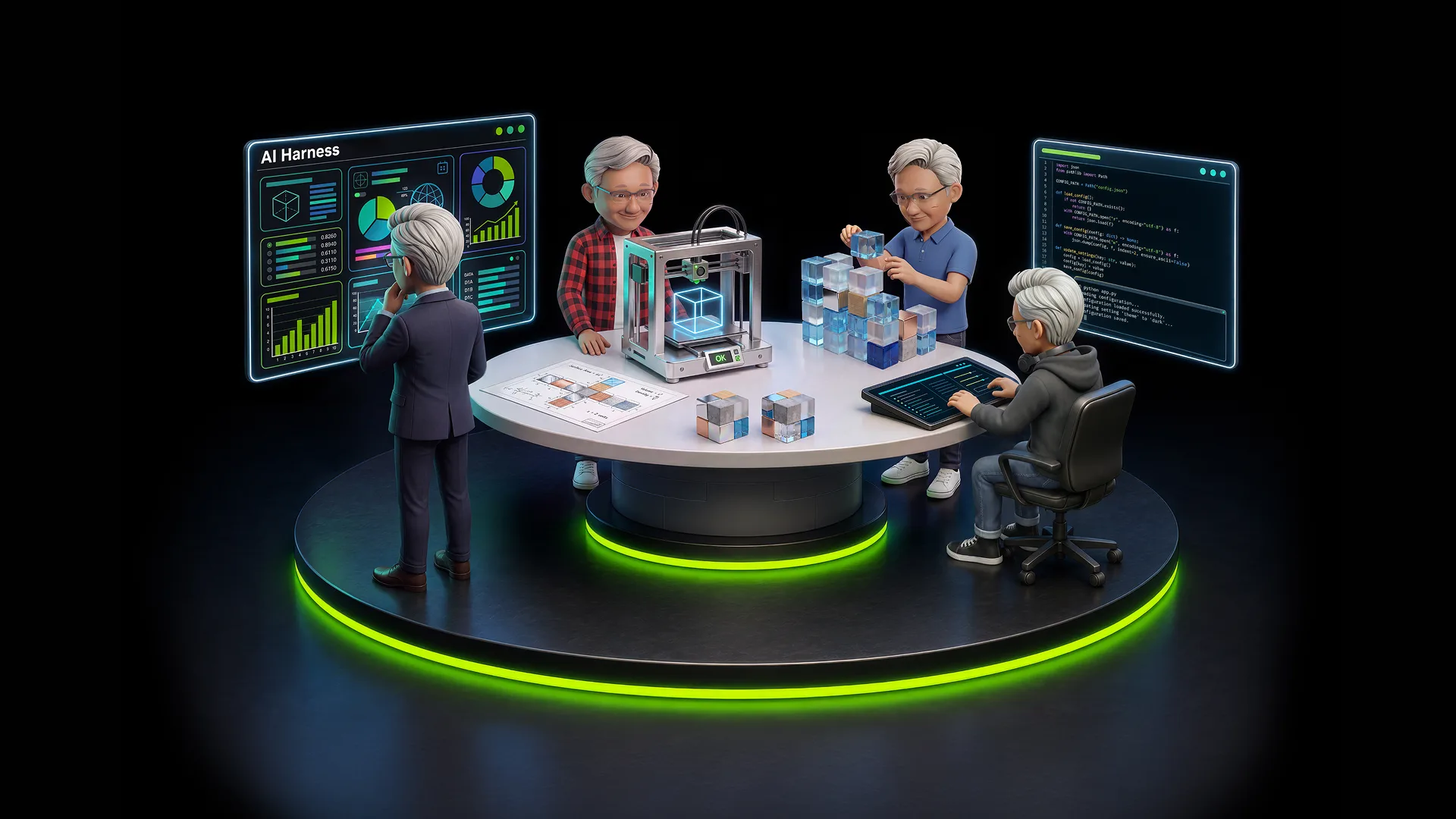
NVIDIA Labs has released NOOA (NVIDIA Labs Object-Oriented Agents), an open-source research preview designed to improve AI agent performance. This framework emphasizes the importance of the "harness"—the architecture surrounding the model—in shaping outcomes, managing context, executing actions, and handling state. NOOA aims to simplify agent development by treating agents as standard Python classes, allowing for traditional software development practices.
Key Points
- NOOA structures agents as single Python classes, with methods as capabilities, fields as state, and docstrings as prompts.
- Type annotations in NOOA serve as enforced contracts, and LLM-driven loops complete method bodies marked by ellipses at runtime.
- The framework includes a long-term memory subsystem that allows agents to curate and persist typed, relational memory in a human-readable SQLite store.
- NOOA achieved 82.2% on SWE-bench Verified with GPT-5.5, surpassing the published leaderboard SOTA of 79.2%.
- On CyberGym L1, NOOA solved 86.8% with GPT-5.5, positioning it as a top-scoring open-source agent.
- A single NOOA agent reached 50.2% mean RHAE on ARC-AGI-3 with GPT-5.5, and 85.1% with GPT-5.6-sol.
- NOOA demonstrated efficiency, achieving 82.2% on SWE-bench Verified with GPT-5.5 using 29 LLM calls and approximately 1.1 million tokens per task, roughly half the token cost of comparison harnesses for similar or better accuracy.
Context
According to NVIDIA, the design of an agent's harness can significantly impact benchmark results and token costs, even with the same underlying model. NOOA was built on this insight, providing a Python framework, a memory system, capability tests, and benchmark agents with publicly released code, data, and evaluations. This release allows the community to reproduce, challenge, and build upon these results. The framework's approach to agent development integrates capabilities, state, and prompts directly into Python class structures, using type annotations for enforced contracts and LLM-driven loops for method completion.
Why It Matters
For builders and researchers, NOOA offers a structured, open-source approach to agent development that integrates with existing software engineering practices. The framework's emphasis on a robust harness design and efficient memory management could lead to more accurate and cost-effective AI agents, particularly in complex domains like software engineering and cybersecurity.
What To Do
- Review the NOOA framework's open-source code and documentation to understand its object-oriented design principles.
- Compare the benchmark results and token cost efficiencies of NOOA against other agent harnesses for specific use cases.
- Explore the memory subsystem's SQLite implementation for managing long-term, typed, and relational agent memory.
- Test the framework's capabilities in your own agent development projects, particularly for tasks requiring complex reasoning or knowledge accumulation.