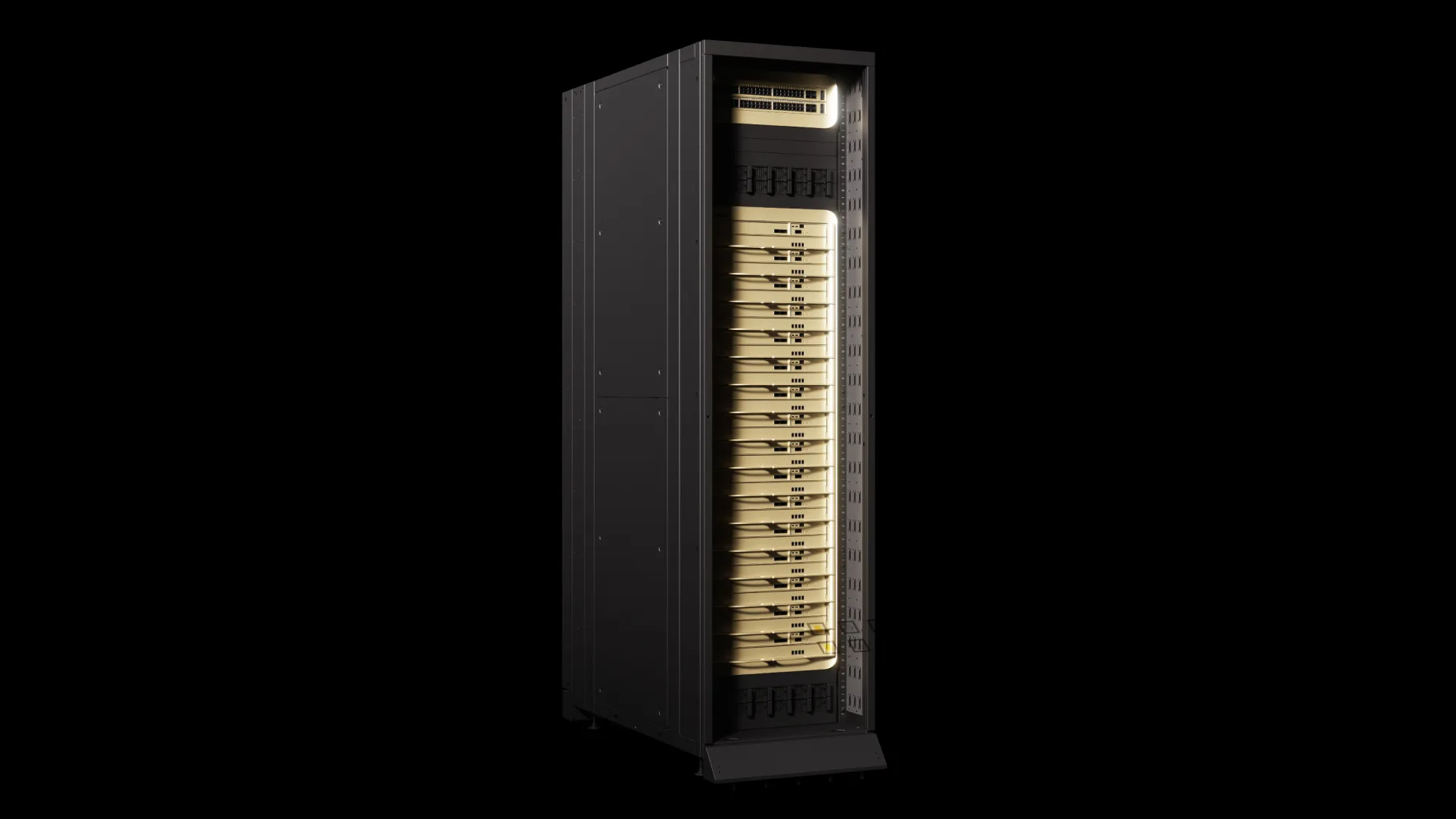
NVIDIA has introduced the Vera Rubin platform, which prioritizes performance per watt as a key metric for AI factory value. The platform aims to maximize output within the limited power budgets of AI factories, addressing the constraint of power in AI workloads.
Key Points
- The NVIDIA Vera Rubin platform is designed for power-efficient AI at scale.
- NVIDIA Vera Rubin NVL72 delivers performance per watt across diverse AI compute demands, including large-batch throughput and high-interactivity small batches.
- NVIDIA DSX MaxLPS software enables shifting power between racks, recovering stranded capacity, and provisioning up to 40% more GPUs and 35% higher token throughput within the same power envelope.
- Rack-level capacitors and Intelligent Power Smoothing in Vera Rubin NVL72 absorb bursty power spikes, allowing planning around sustained demand.
- The NVIDIA Groq 3 LPX deterministic execution model enables cycle-exact scheduling of compute and data movement across all 256 LPU chips.
- Preemptive Power (PEP) and Clock Period Synthesis (CPS) use predictable current-demand curves to reduce voltage droop by over 60% and lower the voltage guardband.
- Pairing Groq 3 LPX with Vera Rubin NVL72 achieves up to 35x higher throughput per megawatt compared to the previous-generation GB200 NVL72 for 2T+ parameter models at long context and high interactivity.
Context
According to NVIDIA, power is a defining constraint for AI factories, making performance per watt the ultimate measure of an AI platform's value. The Vera Rubin platform addresses this by integrating innovations at both factory and rack levels to manage power efficiently.
Why It Matters
These advancements offer builders the ability to deploy more compute per megawatt and achieve higher token throughput within existing power constraints, potentially reducing operational costs and increasing the scale of AI deployments.
What To Do
- Explore the NVIDIA DSX MaxLPS documentation to understand factory-level power management.
- Read the technical deep dive on Groq 3 LPX determinism for details on PEP and CPS.
- Review the Groq 3 LPX architecture overview to evaluate the low-latency accelerator for the Vera Rubin platform.