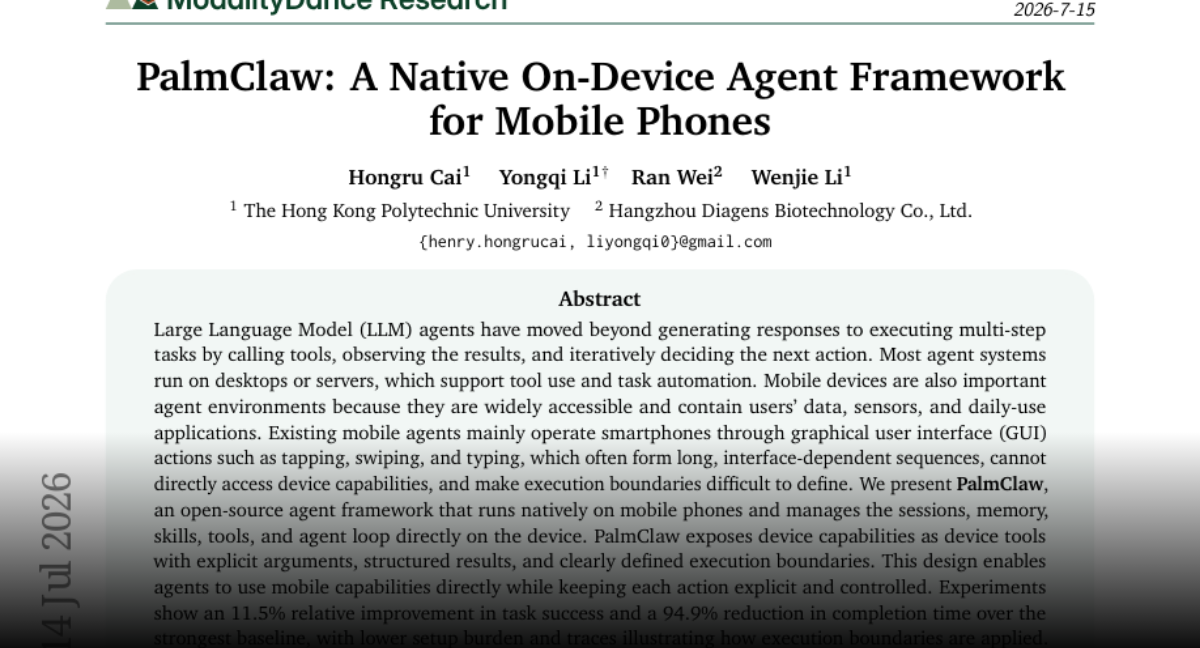
Hongru Cai, Yongqi Li, Ran Wei, and Wenjie Li published a paper on July 14, submitted July 16, introducing PalmClaw, an open-source agent framework designed for native execution on mobile phones.
Key Points
- PalmClaw is an open-source agent framework that operates natively on mobile phones.
- It manages sessions, memory, skills, tools, and the agent loop directly on the device.
- The framework exposes device capabilities as explicit device tools with defined arguments, structured results, and clear execution boundaries.
- This design allows agents to access mobile capabilities directly, maintaining explicit and controlled actions.
- Experiments demonstrated an 11.5% relative improvement in task success and a 94.9% reduction in completion time compared to the strongest baseline.
- The framework also features a lower setup burden.
Context
According to the authors, large language model (LLM) agents have evolved to execute multi-step tasks by calling tools, observing results, and iteratively deciding subsequent actions. While most agent systems operate on desktops or servers, mobile devices represent an important environment due to their accessibility, user data, sensors, and daily applications. Existing mobile agents primarily interact with smartphones through graphical user interface (GUI) actions such as tapping, swiping, and typing. These GUI-based methods often result in long, interface-dependent sequences, lack direct access to device capabilities, and complicate the definition of execution boundaries.
PalmClaw addresses these limitations by providing a native framework that directly exposes device capabilities. This approach enables agents to utilize mobile functions directly, ensuring each action is explicit and controlled, as detailed by the authors.
Why It Matters
For developers and researchers working with LLM agents, PalmClaw offers a method for integrating agent capabilities directly into mobile environments. The framework's native execution and explicit tool exposure could simplify the development of mobile-centric AI applications, potentially leading to more efficient and reliable on-device automation.